

It’s useful to think about our energy system development in more than one dimension. In the early days of programming for climbers, we had a linear view of how a strength - endurance continuum looked.
When things were really hard, it was strength.
When we needed to move quickly, it was power.
When we needed to do a bunch of moves in a row, it was power endurance.
When we did a whole bunch of easier moves, it was endurance.
Although this framework isn’t completely wrong, it doesn’t sufficiently explain how we could prepare to improve our performance.
Understanding that each of our body’s energy systems has both a capability for output and a capability for capacity is helpful in this regard. My favorite analogy at this point is that of a battery. A battery’s output is indicated in voltage. For example, I might have a 9 volt battery. If I have a small battery the size of a coin that puts out 9 volts of energy, it might only be able to do so for a few moments. Yet if I have a battery the size of a small automobile that still just puts out that 9 volts, it would have a much larger capacity, perhaps a capacity that would last several weeks or months.
If a climber is capable of doing really hard boulders but can only do a couple of them in a session, we would see that climber as having a high capability for output but a low capacity. Conversely, if a climber could do pitch after pitch after pitch of moderate climbing but didn’t have the ability to turn it up and do hard moves occasionally, we would say that they are more on the capacity end of things and had a low capability for output.
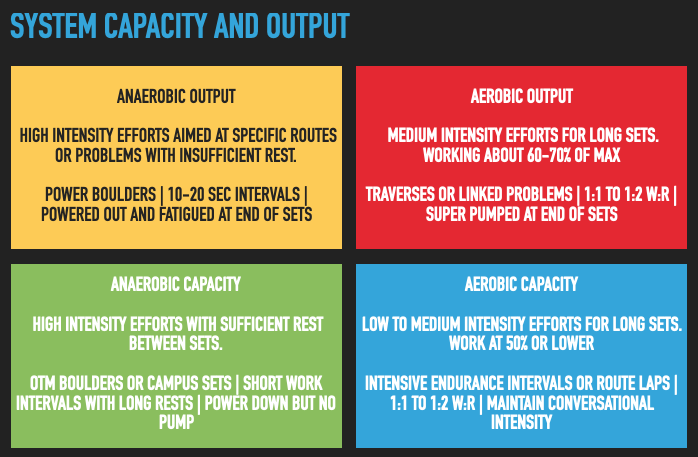
These capacities and outputs are also specific to the energy systems we are using. A boulderer might have high capacity for doing many boulder problems in a row. This would be called anaerobic capacity. That same boulderer might not have the ability to do lots of climbing pitches because he hasn’t developed his aerobic abilities, and so he wouldn’t have a high aerobic capacity.
If you’re confused, I feel for you... It’s taken me years to get my head around these things. Here is a way of looking at these capacities and outputs in a more traditional fashion:
