

Low Threshold Power Endurance
The work we do in climbing is easiest to imagine as a series of clear steps. I do “power” for short boulders, “power endurance” when the moves are slightly easier and the climbing takes slightly longer, “endurance” when I’m fighting a pump, and “capacity” when I’m doing high volumes at moderate grades. It’s clean. We know workouts for each of these. But we also know that power output works more as a series of dimmer knobs than light switches.
It’s messy. There is a big difference between doing a set of 4x4s on less-than-flash-grade problems and linking a 40 move circuit, though all can be considered “power endurance.”
For the purposes of this book, I am going to talk about our power endurance training in terms of high-threshold and low-threshold workouts. Very simply, the high threshold workouts are more powerful, shorter sessions aimed at getting us a bit more time than we’d see in a typical boulder problem. The low threshold ones are longer sessions featuring moves closer to the flash grade, or even “medium” loads, and start to push hard against what we might call endurance sessions. Here are three low-threshold sessions:
Low-Load Density Bouldering
Density training is a staple of muscular endurance training. Instead of trying to increase the duration of your session or to add difficulty to the work sets, you instead try to fit more work at the same difficulty into a fixed amount of time. The first step is to figure out how much work you have time to do. In these sessions, I recommend you do boulder problems, though you could conceivably do a weight circuit or series of hangs or something. This work, however, would fall more into the general endurance category...we are trying to do more climbing if possible.
Most climbers are capable of doing 45-60 minutes of climbing in the work sets of these sessions. The set up is simple: warm-up for 10 minutes or so (I like a combination of cardiac output work and climbing), then set a timer for the planned duration, and start climbing boulders. The problems should be 2-3 grades below your onsight level. Set firm boundaries here, so you don’t get sloppy toward the end of the workout and start adding in problems that are too easy just to get more mileage. Remember, quality counts.
Track the V grades of the boulders you do. At the end of your planned duration, stop the clock and add up all your numbers. Divide this number by the number of minutes in your session. This will give you a session density number. The goal of these workouts is to push that number higher. Aim to do 4-8 sessions at the most before cycling out and moving on to other training.
Long T2P
T2P stands for “traverse-to-problem.” This is one of my favorite specific endurance sessions in our gym, but it might not be ideal for all facilities. You’ll need to have a wall that has enough hold density for low-intensity traversing, and you’ll need to be able to do the traversing. If your gym is a big one with spread-out problems this might not be ideal. The traverses need to be 25-40 moves of easy terrain or big holds, that lead you to a finish problem that is just around your onsight level.
For most sessions, you’ll want to pick 3-4 problems, and then assure that you can do both leftward and rightward traverses. Traversing isn’t the same as climbing up, but we do it occasionally, and we might as well balance out or leftward and rightward skills.
Warm-up. 5-10 minutes, bouldering volume ladder. Do an easy boulder problem, then rest 30-45 seconds. Next, do 2 easy problems with no rest between, then rest 30-45 seconds. Follow this with 3 problems back-to-back. If needed, repeat this sequence a second time. Rest 5 minutes before starting training.
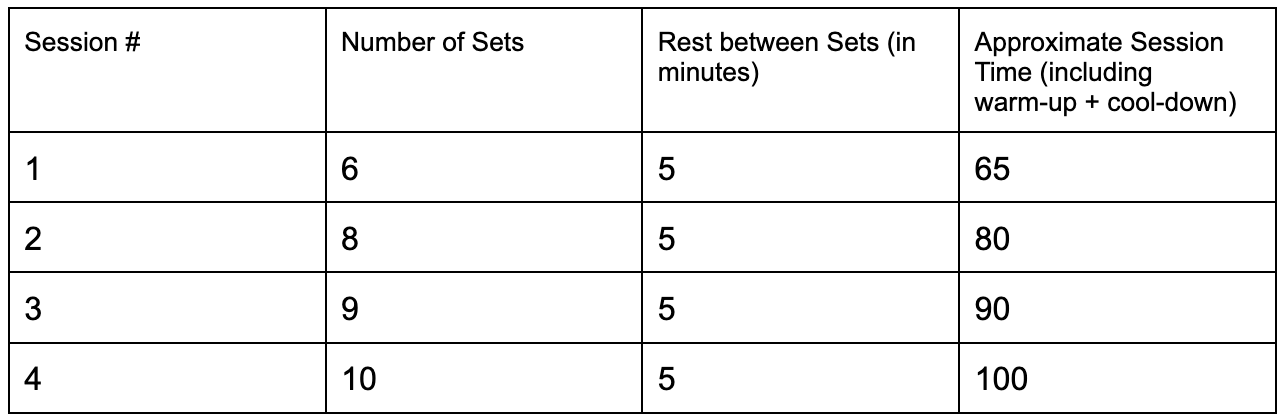
Work Sets. Keep the intensity of the traverses low, and move through the problems as relaxed and calm as possible. Have the discipline to seek not the pump but lots of quality work, instead. Volume should progress over the training cycle, but you might not advance each time. Do not increase the difficulty of the traverse, nor reduce the rest times between efforts. The best factor to manipulate would be to add more sets, which would help increase your capacity. Secondarily, you could increase the number of moves in your traverses, which may add to blood delivery capabilities and local muscular endurance. Save the pump for the power endurance sessions later in the season. Here is a suggested progression:
Cool-down. In most of our endurance work, more low-intensity efforts equal more capacity. Finishing this workout with 8-10 minutes of total-body general endurance (at conversational intensity) is excellent. Air bike or rowing machine.
